 Ringol
Making Ringol: A Solo Devlog from Armenia
Ringol is made by one person, Davit Vardanyan, an independent developer in Armenia. This page is the honest story of how the game came together: what we tried, what we threw away and what we fixed along the way. The dates come from the project's own history.
One idea: the small one goes inside the big one
The whole game grew from a single rule, which is still the tagline on the home screen: the small one goes inside the big one. A ring can only sit inside a bigger ring. Every mode in Ringol is a different way to play with that one rule.
Before a line of the real game existed, the idea lived in quick browser prototypes: a small HTML page for sorting rings and another for dropping rings into a box with physics. They were rough, but they answered the question that matters most: is this fun to touch? It was, so we kept going.
Choosing Godot
On 10 October 2026 the prototypes were ported to Godot 4. The reason was the look. We wanted chunky, glossy rings that catch the light like toys, smooth effects, and one project that builds for Android, iPhone and the web. A game engine made that far easier than an app toolkit would have.
The port was careful. The physics of the box mode was rebuilt so that, with bonuses off, it matched the JavaScript prototype exactly. That gave us a solid base: when something felt different later, we knew it was a real change, not an accident.
For its first days the project was called "Pipes", and the pieces were called pipes or tubes. On 13 October it became Ringol, and the word in every language changed from "pipe" to "ring". In Armenian that meant խողովակ becoming օղակ.
Three modes, after many tries
The two first modes came straight from the prototypes:
- Ring by ring: a calm puzzle with 100 levels. Tap a ring, then a bigger one to put it inside, until each colour is gathered into a nested stack of its own.
- Full box: rings fall into a box with real physics, and you nest them before the pile crosses the line. It has three difficulties and bonus pieces: a bomb, a joker and a vortex.
The third mode took the longest to find. We built and tested a 5 x 5 board, a "lines" variant and a 4 x 4 board. We had bots play them hundreds of times to see whether games were fair and whether skill mattered. Some of these shipped in early test builds, and none of them felt right enough to keep.
On 16 October the third card on the home screen became Ring Chains, which also began as an HTML prototype. You swipe across neighbouring wells to link rings whose sizes follow one another, and a complete chain bursts. It shipped with 600 levels. Testing on an iPhone changed it quickly: we stopped writing sizes on the rings, made the boards portrait with bigger rings, and kept one ring per well so you can always tell rings apart.
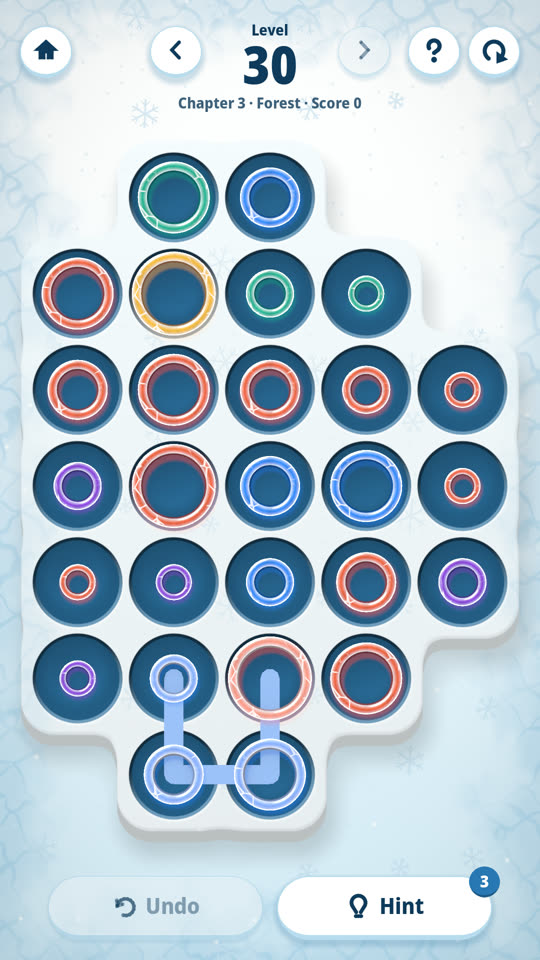
Full box went through the most tuning. Its rules were rewritten more than once: fair piece draws, a danger line that moves with how well you play, waves with level goals and three difficulties. You can read how it plays now in the Full box guide.
Twelve ring materials, all free
On 21 October we added ring materials: classic, candy, wood, jelly, metal, glass, bubble, ice, water, neon, lava and gold. Each one changes how rings look, land, burst and sound, and brings its own world behind the board. The sounds are generated by our own tools and layered with free, public-domain (CC0) recordings.
For the first two days the materials were earned by playing, with trials and an "all rings" purchase. On 23 October we changed our minds: every material is now open to everyone from the first start. Nothing is locked, bought or traded for an ad. Pick any of them on the Rings screen.
Twenty languages
Ringol speaks 20 languages, including Armenian, English, Russian, Arabic (drawn right to left), Hindi, Thai, Japanese, Korean and both forms of Chinese. A tool renders every real screen in all 20 languages and flags any text that does not fit.
The word "ring" alone took some thought. In many languages the obvious word means a finger ring, so we chose the toy-ring word instead: aro in Spanish, argola in Brazilian Portuguese, halka in Turkish.
Light enough for weak phones
A calm game should not drain your battery. Some of the work you never see:
- On the first start the game looks at your phone and measures its frames, then settles on one of four graphics levels, down to a minimal one for weak devices.
- When nothing moves, the screen is not redrawn, and the frame rate is capped at 60.
- In Full box, a pile of rings that has come to rest stops being simulated until something touches it.
- The web version's first download was cut to about 8 MB compressed, with a custom build of the engine.
The Huawei grey-ring bug
The hardest bug came from a weak Huawei phone with a PowerVR graphics chip. Rings left grey shapes behind wherever they had been, and other phones looked fine. That phone could not be connected to a computer, so we built a special diagnostic version that installs beside the game and shows on-screen switches to turn parts of the drawing on and off.
The first fixes, aimed at the rings' colours and shadows, changed nothing. The clue came from a scale switch: when the 3D picture was drawn into the engine's own buffer and then scaled to the screen, the grey was gone. The phone's screen buffer was keeping depth from earlier frames. Since 26 October, on PowerVR chips Ringol draws its 3D into its own buffer, at 90% size at most. It is a touch slower, which you hardly feel, and those phones now start on the lightest graphics level.
Where it is now
Ringol is free with ads, and you can play it on Google Play, the App Store or right in your browser at ringol.app/play. It is still made by one person, one fix at a time. If you are new, start with how to play, or read why we think puzzles can be calm.
More guides
- How to play Ringol: a guide for new playersLearn Ringol in a few minutes: the one rule about rings, the three modes, tap and drag controls, free undo, saved progress, themes and the 20 languages.
- Ring by ring: rules, levels and starsThe rules of Ringol's Ring by ring mode: how a move works, when a level is solved, the 100 levels, moves, stars, Undo, Restart and how the puzzles grow.
- Ring by ring: strategy tips for hard levelsConcrete techniques for Ringol's Ring by ring puzzles: use empty places, plan the biggest ring, avoid burying a colour, count moves and think backwards.
- Full box: how the physics mode of Ringol worksA clear guide to Full box in Ringol: dropping rings, building chains from large to small, the score multiplier, precise drops, the danger line and difficulties.
- Full box bonuses: bomb, joker, vortex and scoring tipsHow Full box bonuses in Ringol work: what earns the bomb, joker and vortex, how to use each one, and how precise drops at x5 lift your score.
- Ring Chains guide: rules, chapters, hints and tipsHow Ring Chains in Ringol works: swipe sets like 4-3-2-1 through neighbouring wells, clear the board, avoid traps, use Undo and hints, and read the chapters.
- The 12 Ring Materials in Ringol: Looks, Sounds, BurstsAll 12 Ringol ring materials, from Classic to Gold: how each one looks, moves, sounds and bursts, the world it brings, and how to switch. All free, none locked.
- Calm Puzzles for Short Breaks: How Ringol Is BuiltWhy a calm puzzle suits a short break, and the design choices behind Ringol: no timers or lives, free undo, short levels, quiet settings and reduced motion.
- Ringol FAQ: ads, offline play, saves, devices, privacyAnswers about Ringol: is it free, when ads show, playing offline, how progress is saved on phones and the web, languages, weak phones, privacy and bug reports.