 Ringol
Full box: how the physics mode of Ringol works
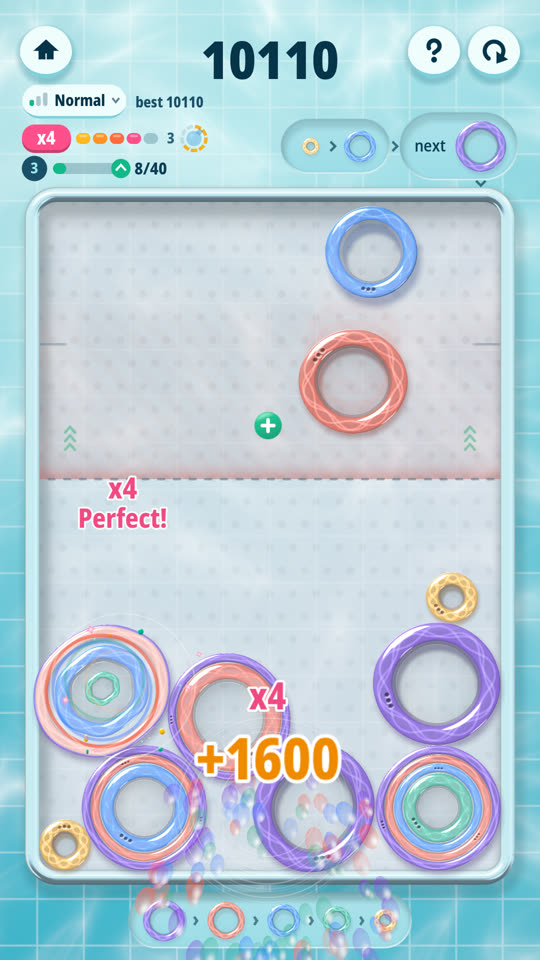
Full box is the physics mode of Ringol. Rings drop into a box, roll, bump into each other and settle where gravity leaves them. Your job is to build chains out of them before the pile grows too tall. It feels looser than the level puzzles, but the rules are exact.
A game never starts on an empty floor: there are already three or four open stacks in the box, so your very first drop is a real choice.
Dropping a ring
The ring you are about to drop sits above the box. Press, drag it left or right, and let go: it falls straight down from where you released it. While you aim, the game shows where the ring will land, so you can line up a drop before you commit to it.
Next to the ring in your hand you can see the rings that come after it. How many depends on the difficulty (more on that below). The upcoming rings are fixed once they are shown, so you can plan a few drops ahead.
How rings settle
There are five ring sizes. A dropped ring does not snap to a grid: it lands, slides off whatever it hits and rolls until it comes to rest. Two things follow from that:
- A ring that hits the top of another ring off centre will usually slide down its side, so a drop that is slightly wide can end up somewhere you did not plan.
- Rings that land on top of a stack can cover it. A covered stack still counts, but it is harder to reach with the ring it needs.
Building a chain from largest to smallest
A stack is a big ring with smaller rings nested inside it. It always waits for one thing: a ring exactly one size smaller than its innermost ring. Drop that ring into it and the stack grows by one.
The chain is finished when the smallest ring goes in. Then the whole stack pops and leaves the box, making room. You can also grow a stack from the outside: drop a ring that is exactly one size bigger straight onto a waiting stack and it takes that stack inside itself.
Scoring
Longer chains pay much more than short ones:
- a chain of 2 rings: 10 points
- 3 rings: 40 points
- 4 rings: 120 points
- all 5 rings: 400 points
So it is almost always worth letting a stack grow to its full five rings instead of closing it early with a small ring.
Precise drops and the multiplier
A precise drop is a ring dropped straight into the stack it fits, so that it goes in before it touches anything else. Dropping a bigger ring straight onto a waiting smaller stack counts too. The game marks the aim when a drop would be precise, and calls out "Perfect!" when it was.
Every precise drop raises the multiplier one step: x1, x1.5, x2, x3, x4, x5. Every chain that pops is paid at the current multiplier, so a full chain at x5 is worth 2000 points instead of 400. A meter on screen shows where you are.
A miss is a drop that could have been precise and was not. It takes the multiplier back down. Two kinds of drops never count as a miss:
- a ring that fits no stack in the box at all, so you can put it wherever it suits you;
- a ring whose only matching stacks are buried, so that no straight drop could reach them.
At the top of the streak, x5, precise play also earns the three bonus pieces: the bomb, the joker and the vortex. They have their own guide: Full box bonuses.
The danger line and levels
Near the top of the box is a danger line. Every ring you drop brings it down a little, and a miss brings it down a bit more. Every chain you pop pushes it back up, and the longer the chain and the higher your multiplier, the bigger the push. A full chain at x5 lifts it the most.
Popped chains also fill the level bar. When you complete a level, the line jumps up, and the next level asks a little more: the line comes down a little faster with every drop. The floor of the box changes its shade with each new level.
The rings are dealt fairly. Every size keeps coming, and the size an open stack is waiting for always turns up within about a dozen rings. You will not lose because a size simply never arrived.
The three difficulty levels
You choose the difficulty on the Full box card of the home screen: one press on Normal, Medium or High starts a game. Each difficulty keeps its own best score.
- Normal: you see three rings ahead, and a miss costs one step of the multiplier.
- Medium: two rings ahead, a miss costs two steps, and the rings come less conveniently.
- High: only the next ring is shown, one miss loses the whole streak, and bombs are rare.
On the harder levels the line also comes down faster. If you are new to the mode, start on Normal.
How the game ends
There is no timer and no move limit. A game ends when a stack stays above the danger line for two seconds; the card then says "Over the line" and shows your score and your best. That short delay is a grace period: if you pop a chain in time, the line rises and the game goes on.
Continue
When a game is over, the card may offer Continue in exchange for a short video ad. It is only there if you want it. It appears only after a game that lasted at least 45 seconds, and you can use it up to twice per game; the second offer comes only after you have played on for a while since the first. If you watch the ad to the end:
- the danger line goes up,
- the stacks that reach too high are taken out of the box (without points),
- you get three quiet seconds before the danger line counts again,
- and the multiplier starts again at x1.
Your score, level and the rings in your hand all stay as they were, and the continued game still counts for your best score.
A few habits that help
- Keep two or three open stacks waiting for different sizes, so most rings have somewhere useful to go.
- Use the rings shown ahead: if a small ring is coming, leave its stack uncovered.
New to Ringol? Start with how to play for all three modes, or see why the game is built to be calm. When you are ready, play Full box.
More guides
- How to play Ringol: a guide for new playersLearn Ringol in a few minutes: the one rule about rings, the three modes, tap and drag controls, free undo, saved progress, themes and the 20 languages.
- Ring by ring: rules, levels and starsThe rules of Ringol's Ring by ring mode: how a move works, when a level is solved, the 100 levels, moves, stars, Undo, Restart and how the puzzles grow.
- Ring by ring: strategy tips for hard levelsConcrete techniques for Ringol's Ring by ring puzzles: use empty places, plan the biggest ring, avoid burying a colour, count moves and think backwards.
- Full box bonuses: bomb, joker, vortex and scoring tipsHow Full box bonuses in Ringol work: what earns the bomb, joker and vortex, how to use each one, and how precise drops at x5 lift your score.
- Ring Chains guide: rules, chapters, hints and tipsHow Ring Chains in Ringol works: swipe sets like 4-3-2-1 through neighbouring wells, clear the board, avoid traps, use Undo and hints, and read the chapters.
- The 12 Ring Materials in Ringol: Looks, Sounds, BurstsAll 12 Ringol ring materials, from Classic to Gold: how each one looks, moves, sounds and bursts, the world it brings, and how to switch. All free, none locked.
- Calm Puzzles for Short Breaks: How Ringol Is BuiltWhy a calm puzzle suits a short break, and the design choices behind Ringol: no timers or lives, free undo, short levels, quiet settings and reduced motion.
- Ringol FAQ: ads, offline play, saves, devices, privacyAnswers about Ringol: is it free, when ads show, playing offline, how progress is saved on phones and the web, languages, weak phones, privacy and bug reports.
- Making Ringol: A Solo Devlog from ArmeniaHow one developer in Armenia made Ringol: from a small-ring-in-a-big-ring idea and web prototypes to Godot, three modes, 12 materials and 20 languages.