 Ringol
Calm Puzzles for Short Breaks: How Ringol Is Built
Plenty of people reach for a small puzzle on a tea break, on a bus, or while a kettle boils. A good one gives you something tidy to finish, then lets you go. Ringol was designed around that idea. This guide explains what makes a puzzle feel calm rather than stressful, and which concrete choices in Ringol aim for that.
This is about game design, not health. We make no claims about what a game does to your mind or body. We only describe how the game behaves, so you can decide whether it suits the way you like to take a break.
What makes a puzzle feel calm
Many people find that a puzzle feels relaxing when a few things are true:
- You set the pace. Nothing counts down while you think.
- Mistakes are cheap. A wrong move can be taken back instead of costing you the game.
- The goal is clear. You can see what "done" looks like before you start.
- A session is short. You can finish something in a few minutes and stop without losing anything.
- The screen and sound stay gentle. No alarms, no flashing pressure.
The same puzzle can feel restful or tense depending on these rules around it. Ringol tries to get them right.
One simple rule
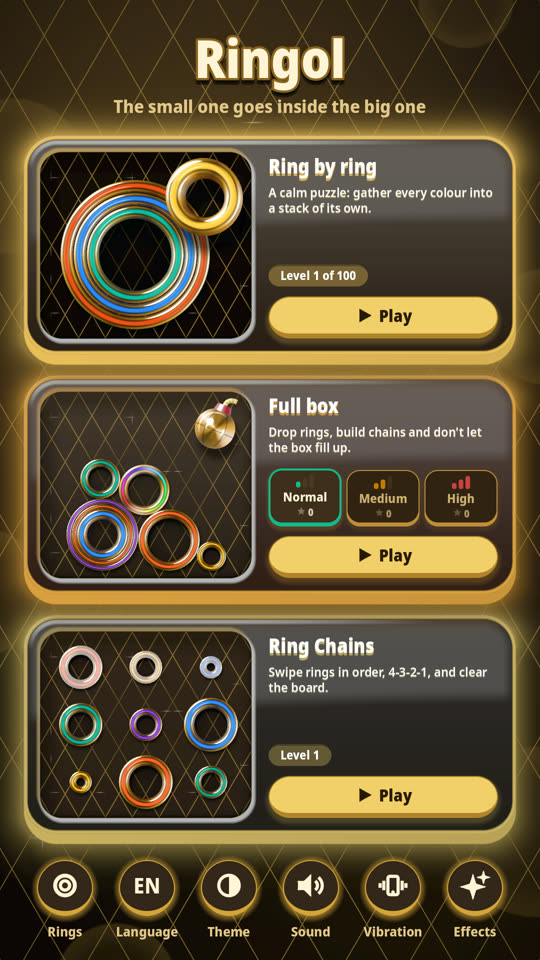
Everything in Ringol rests on a single idea, written on the home screen: the small one goes inside the big one. A smaller ring fits inside a bigger one, and that is all you need to know to start. There is no long tutorial to read. The first time you open a mode, a hand shows the real first move on the real board, with one short line of text. It goes as soon as you touch the board (or by itself after a few rounds), and it does not come back.
No timers and no lives in Ring by ring
Ring by ring is the calmest mode. Rings of several colours are mixed across the tray, and you gather every colour into a stack of its own, the big ring outside and the small one in the middle. There are 100 levels.
There is no clock and there are no lives. You can look at the board for as long as you like before the first move, put the phone down in the middle of a level, and come back later. A move that does not fit is simply refused with a short "Does not fit"; nothing is lost.
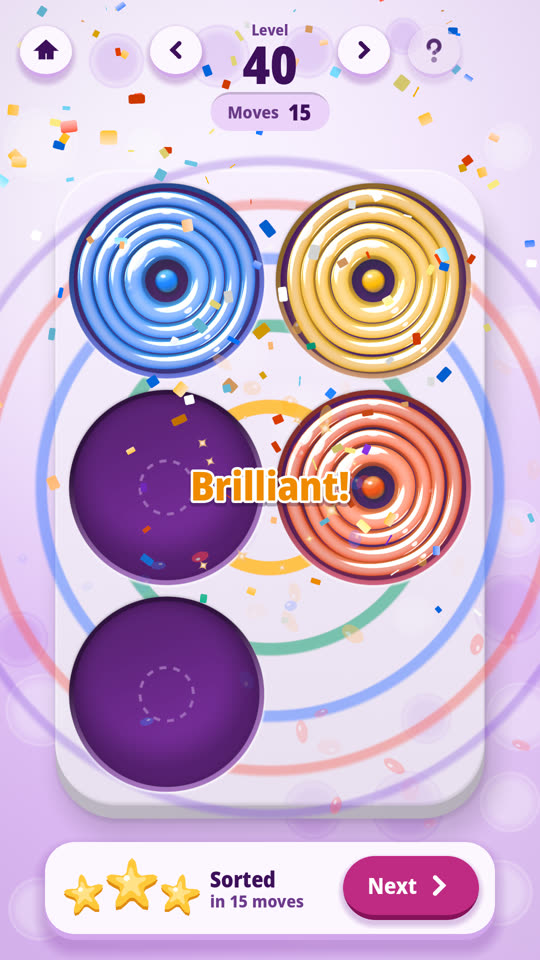
Each level counts your moves, and a level you solve shows how many moves it took. That count is an invitation, not a penalty: you can finish a level in any number of moves and go on, or replay it later to find a tidier solution.
Undo is free
Being able to take a move back changes how a puzzle feels. In Ring by ring, Undo takes a move back and Restart starts the level again. Neither costs anything. You can try an idea and step back if it was wrong.
If you sit still for a while without moving, the game lights up a possible target as a quiet hint. It does not interrupt you or put up a message.
Ring chains: undo and hints, no hurry
In Ring chains you swipe through neighbouring rings from the biggest to the smallest, for example 4, 3, 2, 1, and a whole set bursts. Clear the board to win. This mode has a real trap: taking the wrong set can leave rings that can never meet.
Instead of punishing that, the game helps you out of it. Undo is free and unlimited. If no set is left, it tells you plainly: "No set left. Undo!" A hint shows a set that is safe to take. You start with 3 hints and earn one more for every 10 levels you win, and when the hint cannot be sure a board is still solvable, it says so and suggests Undo instead of using up a hint.
Short levels you can finish
A break is short, so the levels are too. The early levels of Ring chains take roughly 10 to 30 seconds, and a Ring by ring level is one small board with a single goal. Your progress is saved, so stopping after one level costs nothing. The game also works offline, which helps when the break happens somewhere without a signal.
Gentle on the eyes and ears
Several settings on the home screen let you shape how much the game asks of your senses:
- Sound can be turned off.
- Vibration can be turned off.
- Effects switches to reduced motion: particles, screen shake, flying icons and pulses are dropped, and the game reads the same without them. Until you touch this switch, Ringol follows your device's own "reduce motion" setting.
- Theme lets you choose light or dark.
The rings are drawn so they can be told apart by size as well as by colour, and the game is played with one hand in portrait.
Ads that wait for a pause
Ringol is free and contains ads. In the level modes, a full-screen ad only appears after you press Next on a finished level, never in the middle of a level and never when you press Undo, Restart or Hint. A new player gets a few levels without ads first, and there are limits on how often ads can appear. Video ads that give you something, like an extra hint, are only shown if you ask for them.
When you want a bit more pressure
Calm does not have to mean one speed. Full box is the livelier mode: you drop rings into a box, they roll and settle, and you close chains before a danger line comes down. It has a score and it ends. Even there, the design avoids unfair losses: rings are dealt so that a size a stack needs always comes back within a limited number of pieces, and you choose one of three difficulties. If you just want a quiet few minutes, stay with Ring by ring or Ring chains; if you want a little tension, Full box is there.
Try it
The best way to see whether Ringol fits your breaks is to play one level. You can play Ringol in your browser or get it on Google Play and the App Store. If you are new, How to play covers all three modes in a few minutes.
More guides
- How to play Ringol: a guide for new playersLearn Ringol in a few minutes: the one rule about rings, the three modes, tap and drag controls, free undo, saved progress, themes and the 20 languages.
- Ring by ring: rules, levels and starsThe rules of Ringol's Ring by ring mode: how a move works, when a level is solved, the 100 levels, moves, stars, Undo, Restart and how the puzzles grow.
- Ring by ring: strategy tips for hard levelsConcrete techniques for Ringol's Ring by ring puzzles: use empty places, plan the biggest ring, avoid burying a colour, count moves and think backwards.
- Full box: how the physics mode of Ringol worksA clear guide to Full box in Ringol: dropping rings, building chains from large to small, the score multiplier, precise drops, the danger line and difficulties.
- Full box bonuses: bomb, joker, vortex and scoring tipsHow Full box bonuses in Ringol work: what earns the bomb, joker and vortex, how to use each one, and how precise drops at x5 lift your score.
- Ring Chains guide: rules, chapters, hints and tipsHow Ring Chains in Ringol works: swipe sets like 4-3-2-1 through neighbouring wells, clear the board, avoid traps, use Undo and hints, and read the chapters.
- The 12 Ring Materials in Ringol: Looks, Sounds, BurstsAll 12 Ringol ring materials, from Classic to Gold: how each one looks, moves, sounds and bursts, the world it brings, and how to switch. All free, none locked.
- Ringol FAQ: ads, offline play, saves, devices, privacyAnswers about Ringol: is it free, when ads show, playing offline, how progress is saved on phones and the web, languages, weak phones, privacy and bug reports.
- Making Ringol: A Solo Devlog from ArmeniaHow one developer in Armenia made Ringol: from a small-ring-in-a-big-ring idea and web prototypes to Godot, three modes, 12 materials and 20 languages.