 Ringol
Ring by ring: rules, levels and stars
Ring by ring is the calm puzzle mode of Ringol. There is no timer, no lives and nothing falling from the sky: just a tray of mixed rings and one question, how do you put every colour back together? This guide explains the rules exactly as the game applies them, so you know what is allowed, what counts as a win and how the stars are earned.
The goal
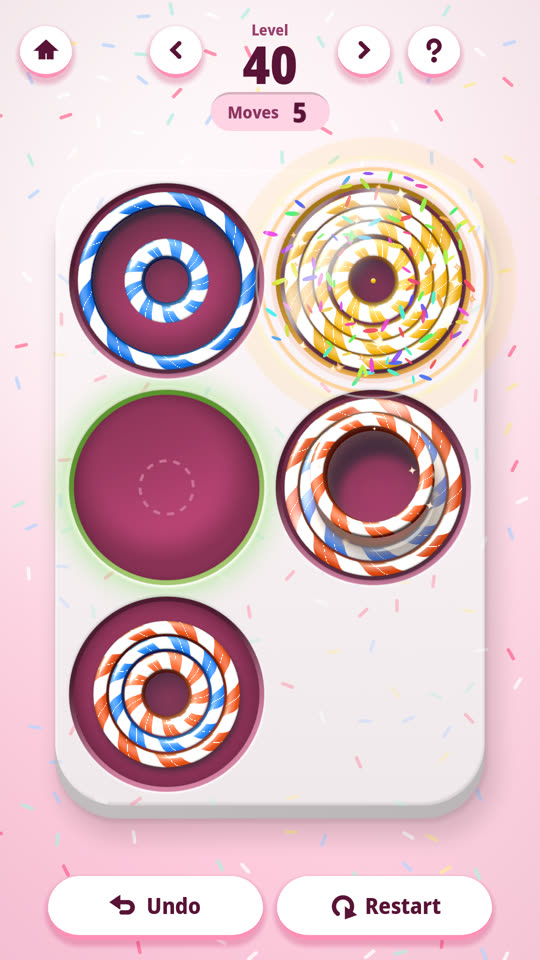
Each level shows a row of places, called stacks. Every stack holds rings nested inside each other, the big ring outside and the smaller ones within it. At the start the colours are mixed up.
Your job is to gather each colour into a stack of its own: the big ring outside, the small one in the middle, and no other colour in between. When every colour sits in its own stack, the level is sorted.
Every colour has exactly one ring of each size, so a finished stack always holds a full set: three rings on the early levels, four rings later on.
How a move works
A move is two taps:
- Tap a stack to pick up its innermost ring. That is the only ring you can take from a stack; the bigger ones around it stay put until it is gone.
- Tap the stack where it should go. The ring drops inside the innermost ring of that stack.
There is one rule to remember: a smaller ring only fits inside a bigger one. You can put a ring into a stack when:
- the stack is empty, or
- the innermost ring of that stack is strictly bigger than the ring you are moving.
Colour does not matter for a single move. You may park a small blue ring inside a big red one if that helps you free something else. Two rings of the same size never fit into each other, and if you try a move that breaks the rule, the game shows "Does not fit" and nothing changes.
Because rings must get smaller toward the middle, a stack can never hold two rings of the same size. That is why empty stacks are so valuable: an empty stack accepts any ring, even the biggest one.
What counts as solved
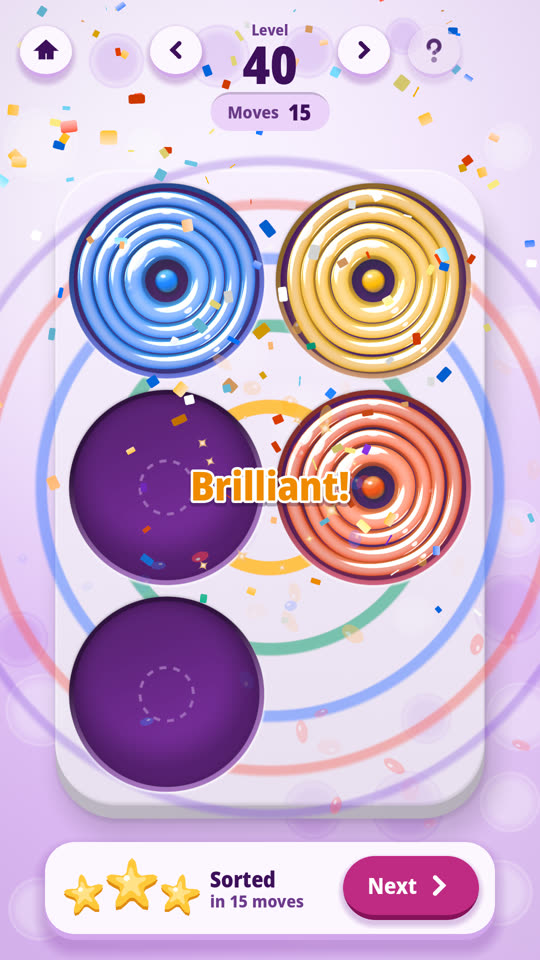
A stack is complete when it holds a full set of one colour, every size from the biggest to the smallest. The level is solved when every stack is either complete or empty. Each level has two more stacks than it has colours, so when you finish, two stacks are left empty.
When you solve a level, a banner says "Sorted" with the number of moves you used, and the "Next" key takes you to the following level. On the very last level the banner tells you "That was the last level."
Moves and stars
The game counts your moves on every level. Each level comes with a stored solution, and when you finish, the game compares your move count with the length of that solution and gives you one to three stars:
- Three stars if you finish within about a fifth more moves than the stored solution, plus one move of slack.
- Two stars if you finish within about 60% more moves than the stored solution, plus three moves.
- One star for any finish. Solving a level always earns at least one star.
The thresholds are deliberately generous. They are meant as a pat on the back, not a grade. For the larger levels the stored solution is not always the shortest one possible, so a careful player can sometimes beat it. After a three-star level you can share a picture of your result from the win card.
Undo and Restart
Two keys help you whenever a plan goes wrong:
- Undo takes your last move back. It is free and unlimited: you can step back all the way to the start. An undone move is also taken off the move counter, so trying an idea and taking it back does not cost you stars.
- Restart puts the level back to its first layout and resets the move counter to zero.
Once a level is sorted, Undo switches off; the result is yours. If you forget the rules, the "?" key at the top opens a short "How to play" card.
If you sit still for a while (about seven seconds without touching the board), the game gently lights up a move worth trying. It is never a move the rules would refuse. This hint stays off while the Effects setting is turned off.
How many levels, and how they grow
Ring by ring has 100 levels, and they get harder in clear steps. The home screen shows where you are, for example "Level 12 of 100", and the game remembers your level between sessions. The small arrows at the top let you go back to an earlier level or skip ahead; nothing is locked.
Difficulty grows in two ways: more colours, and bigger sets of rings.
- Levels 1 to 8: two colours, three ring sizes, four stacks. The first levels can be solved in four to seven moves.
- Levels 9 to 22: three colours, three sizes, five stacks.
- Levels 23 to 36: four colours, three sizes, six stacks.
- Levels 37 to 52: a fourth ring size arrives. Three colours of four rings each, five stacks.
- Levels 53 to 68: four colours, four sizes, six stacks.
- Levels 69 to 84: five colours, four sizes, seven stacks.
- Levels 85 to 100: six colours, four sizes, eight stacks, which means 24 rings on the tray.
The stored solutions grow with them, from 4 moves on the first level to around 45 moves on level 100. A few early levels start with an empty stack to make the first steps easier; later levels usually start with every stack filled, so you have to make room yourself.
A few words before you start
The first two levels show a short explanation above the keys, and on your very first visit a hand shows you the first move. After that you are on your own, which is exactly the point. If you want strategies for the bigger levels, read the Ring by ring tips. For an overview of all three modes, see how to play Ringol, and to change how your rings look, open the ring materials guide.
Ready to sort? Play Ringol for free on the web, or on Google Play and the App Store.
More guides
- How to play Ringol: a guide for new playersLearn Ringol in a few minutes: the one rule about rings, the three modes, tap and drag controls, free undo, saved progress, themes and the 20 languages.
- Ring by ring: strategy tips for hard levelsConcrete techniques for Ringol's Ring by ring puzzles: use empty places, plan the biggest ring, avoid burying a colour, count moves and think backwards.
- Full box: how the physics mode of Ringol worksA clear guide to Full box in Ringol: dropping rings, building chains from large to small, the score multiplier, precise drops, the danger line and difficulties.
- Full box bonuses: bomb, joker, vortex and scoring tipsHow Full box bonuses in Ringol work: what earns the bomb, joker and vortex, how to use each one, and how precise drops at x5 lift your score.
- Ring Chains guide: rules, chapters, hints and tipsHow Ring Chains in Ringol works: swipe sets like 4-3-2-1 through neighbouring wells, clear the board, avoid traps, use Undo and hints, and read the chapters.
- The 12 Ring Materials in Ringol: Looks, Sounds, BurstsAll 12 Ringol ring materials, from Classic to Gold: how each one looks, moves, sounds and bursts, the world it brings, and how to switch. All free, none locked.
- Calm Puzzles for Short Breaks: How Ringol Is BuiltWhy a calm puzzle suits a short break, and the design choices behind Ringol: no timers or lives, free undo, short levels, quiet settings and reduced motion.
- Ringol FAQ: ads, offline play, saves, devices, privacyAnswers about Ringol: is it free, when ads show, playing offline, how progress is saved on phones and the web, languages, weak phones, privacy and bug reports.
- Making Ringol: A Solo Devlog from ArmeniaHow one developer in Armenia made Ringol: from a small-ring-in-a-big-ring idea and web prototypes to Godot, three modes, 12 materials and 20 languages.