 Ringol
Ring by ring: strategy tips for hard levels
Ring by ring starts gently, but by the last stretch of its 100 levels you are sorting 24 rings of six colours across eight places. At that point tapping around until something fits stops working. Here are techniques that follow directly from the rules. If you are new to the mode, read the Ring by ring guide first.
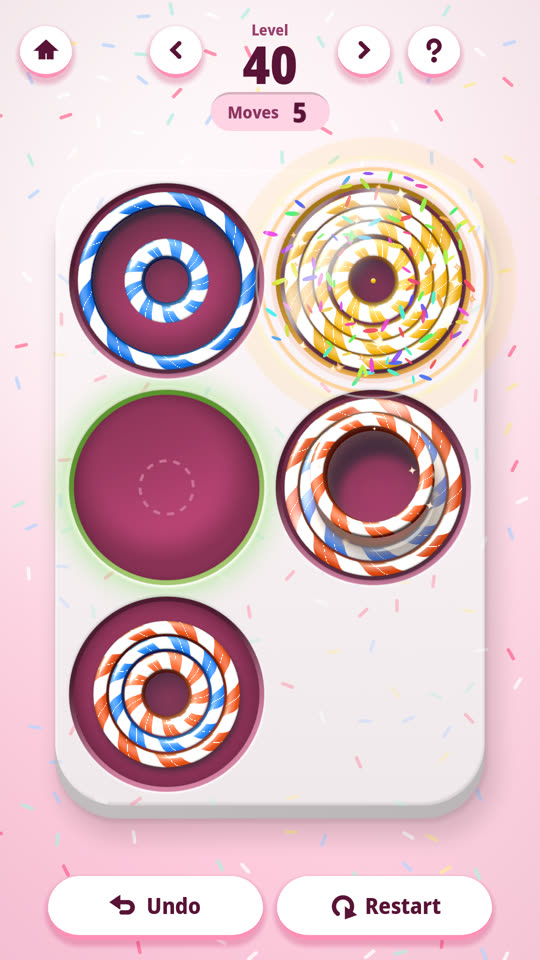
The rules that shape every strategy
Everything below follows from a few exact rules:
- You can only move the innermost ring of a place.
- It can go into an empty place, or into a place whose innermost ring is strictly bigger. Colour does not matter for the move itself; a small blue ring fits inside a big red one.
- A place is finished when it holds a full set of one colour, from the biggest ring outside to the smallest in the middle.
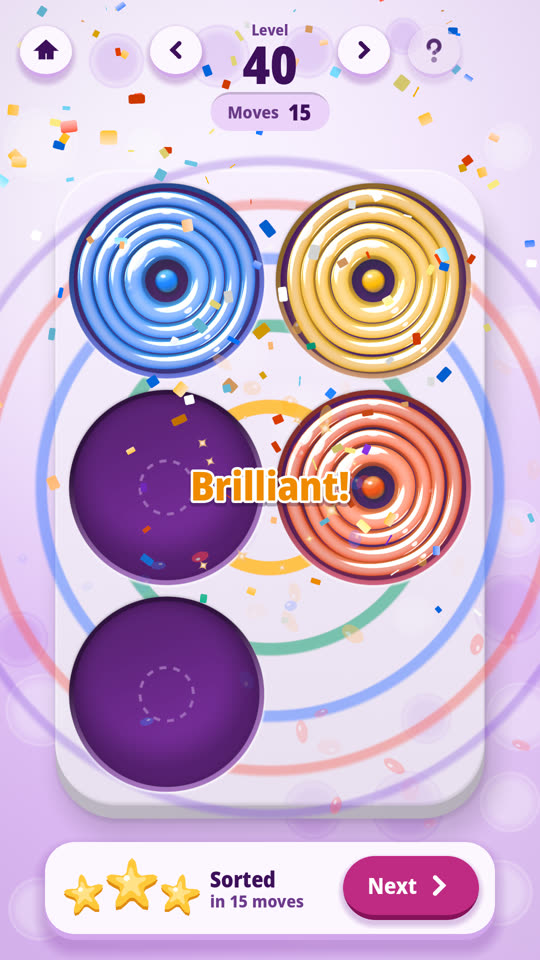
- There are always two more places than colours. Two colours means four places; six colours means eight. When a level is solved, two places are left empty.
- Undo has no limit and takes a move off the counter. Restart puts the level back to its starting layout and the counter back to zero.
Levels 1 to 36 use three ring sizes; from level 37 on there are four. When the fourth size arrives, the colour count drops back to three for a while, but each stack now needs one more step to build, so the levels get noticeably deeper.
1. Treat empty places as precious
An empty place is the only spot that accepts any ring at all, so it is your most flexible resource. Most levels start with every place partly filled, which means your first job is often to make an empty place by moving a short stack's rings into bigger ones elsewhere.
Once you have an empty place, think before dropping a small ring into it. A size 1 ring in an empty place turns your most useful spot into one that accepts nothing, because nothing is smaller than the smallest ring. A good habit: only use an empty place for a ring that cannot go anywhere else, or for a big ring that will start a finished stack.
2. Plan where the biggest ring goes
The biggest ring of a colour can never go inside another ring. Its only possible destination is an empty place. So for each colour, ask early: is its biggest ring already at the outside of a place? If it is, that place is a natural home for the colour, and you want to clear away whatever sits on top of it.
If the biggest ring is buried in the middle of a stack, someone has to dig it out and you need an empty place ready for it. Colours whose biggest ring is already in position are usually the cheapest to finish, so start with them.
3. Avoid burying a colour
Because any smaller ring fits into any bigger one, it is easy to drop a ring of the wrong colour into a stack you were building. That ring now blocks the stack: you have to take it out again before the next size of the right colour can go in.
Before each move, look at where the ring lands. Putting a ring onto its own colour at exactly the next size up is progress. Putting it onto another colour is parking. Parking is fine and often necessary, but prefer to park on stacks you are not about to build, and remember which rings you parked where.
Watch out for small rings especially. Every time a size 1 or size 2 ring of the wrong colour lands on a stack, it shuts out most of the rings you might want there next.
4. Count your moves
The move counter shows how many moves you have made, and a solved level earns one to three stars. The stars are measured against the length of a stored solution for that level, with generous room: three stars allow roughly 20 percent more moves than that solution plus one, and two stars about 60 percent more plus three. For the larger levels the stored solution is not always the shortest one, so beating it is possible.
Since undo takes moves off the counter, exploring costs you nothing: try a line of five or six moves and undo back if it opens nothing.
5. Think backwards
When a level feels stuck, start from the end. Pick one colour and ask what the last move to finish it must be: the smallest ring dropping onto the size 2 of the same colour. Then what must happen before that: on a four-size level, the size 2 needs to sit on the size 3, which needs to sit on the size 4 in some place.
Now look at what stands in the way of each step. Which rings are on top of the pieces you need? Where can those rings go? Working backwards like this turns a mess of 24 rings into a short list of specific obstacles, and often shows you which two or three rings need to move first.
A simple order for hard levels
- Find any colour that is already partly built in order from the outside. Finish that one first.
- Free up an empty place, ideally by emptying a short stack into bigger rings.
- Use that empty place for a biggest ring that is buried, or keep it free as long as you can.
- Work one colour at a time, thinking backwards from its smallest ring.
- When you hit a dead end, undo several moves rather than restarting, unless the layout has become hopelessly tangled.
When you need a nudge
If you leave the board alone for about seven seconds, the game quietly highlights one legal move. While you are still following the level's stored solution, that is its next move; otherwise, when it can find one, it suggests nesting a ring into the next size up of its own colour. It never points at a move the game would refuse. There is no timer and no lives, so you can also just put the phone down and come back later. More on that idea in why Ringol is built to be calm.
Ready to try these on a real board? Play Ringol on the web, or find answers to common questions in the FAQ.
More guides
- How to play Ringol: a guide for new playersLearn Ringol in a few minutes: the one rule about rings, the three modes, tap and drag controls, free undo, saved progress, themes and the 20 languages.
- Ring by ring: rules, levels and starsThe rules of Ringol's Ring by ring mode: how a move works, when a level is solved, the 100 levels, moves, stars, Undo, Restart and how the puzzles grow.
- Full box: how the physics mode of Ringol worksA clear guide to Full box in Ringol: dropping rings, building chains from large to small, the score multiplier, precise drops, the danger line and difficulties.
- Full box bonuses: bomb, joker, vortex and scoring tipsHow Full box bonuses in Ringol work: what earns the bomb, joker and vortex, how to use each one, and how precise drops at x5 lift your score.
- Ring Chains guide: rules, chapters, hints and tipsHow Ring Chains in Ringol works: swipe sets like 4-3-2-1 through neighbouring wells, clear the board, avoid traps, use Undo and hints, and read the chapters.
- The 12 Ring Materials in Ringol: Looks, Sounds, BurstsAll 12 Ringol ring materials, from Classic to Gold: how each one looks, moves, sounds and bursts, the world it brings, and how to switch. All free, none locked.
- Calm Puzzles for Short Breaks: How Ringol Is BuiltWhy a calm puzzle suits a short break, and the design choices behind Ringol: no timers or lives, free undo, short levels, quiet settings and reduced motion.
- Ringol FAQ: ads, offline play, saves, devices, privacyAnswers about Ringol: is it free, when ads show, playing offline, how progress is saved on phones and the web, languages, weak phones, privacy and bug reports.
- Making Ringol: A Solo Devlog from ArmeniaHow one developer in Armenia made Ringol: from a small-ring-in-a-big-ring idea and web prototypes to Godot, three modes, 12 materials and 20 languages.